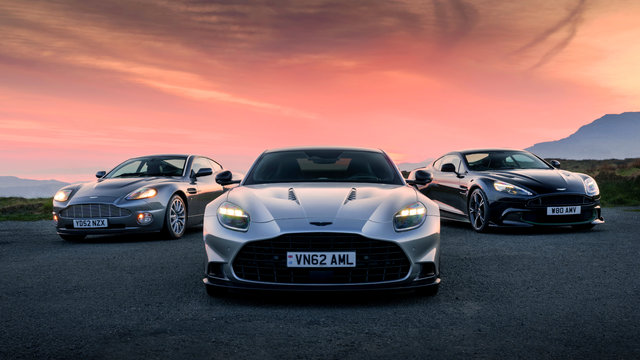
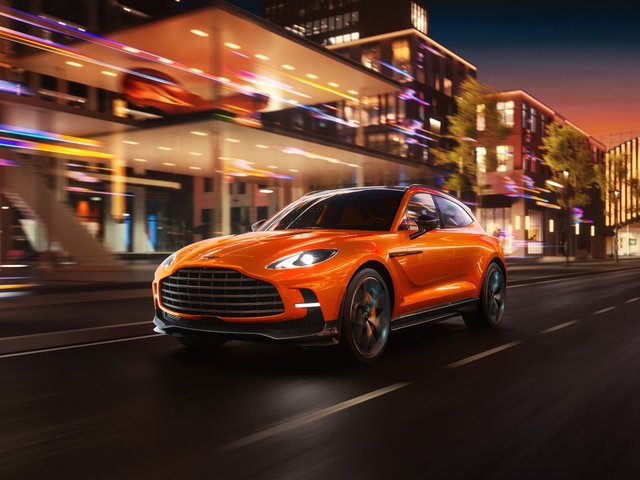
The 2001 Geneva Motor Show introduced a V12 grand tourer that would define Aston Martin's flagship performance for the next quarter-century. The original Vanquish delivered 460 bhp (343 kW) from a naturally aspirated 6.0-litre V12. Today's third-generation model produces 835 PS (614 kW) from a 5.2-litre twin-turbo V12 - the most powerful production Aston Martin ever built.
Three distinct generations have advanced the Vanquish formula while maintaining the core architecture: a front-engined V12 layout, hand-crafted luxury, and driver-focused dynamics. For buyers across Canada evaluating flagship GT performance, this 25-year lineage demonstrates continuous refinement in construction methods, transmission technology, and power delivery.
The 2001 Original: Pioneering Construction and Transmission Technology
The first-generation V12 Vanquish introduced technologies that would influence Aston Martin's engineering direction for decades. Built at the historic Newport Pagnell facility, it was the last model produced at that location.
The original Vanquish featured a 6.0-litre naturally aspirated V12 producing 460 bhp (343 kW). Power delivery was managed through an F1-style paddle-shift gearbox, a significant departure from traditional manual transmissions in GT cars of that era. The drive-by-wire throttle system provided precise throttle response, while the aluminium and carbon composite construction reduced weight without compromising structural rigidity.
Key innovations in the 2001 Vanquish:
- Aluminium and carbonfibre construction for reduced mass
- F1-style paddle-shift gearbox (automated manual transmission)
- Drive-by-wire throttle for precise power delivery
- 6.0-litre naturally aspirated V12 engine
The Vanquish S and top variants followed, refining the formula with incremental power gains and chassis improvements.
The 2012 Second Generation: Aerospace-Grade Carbon and Refined Dynamics
The second-generation Vanquish, introduced in 2012, advanced construction sophistication and performance. The 6.0-litre V12 received dual variable valve timing, increasing output to 565 bhp (421 kW). This generation achieved 0-62 mph in 4.1 seconds and reached a top speed of 295 km/h (183 mph).
Construction methods advanced dramatically. Full carbonfibre body panels, influenced by the One-77 hypercar program, reduced weight while improving torsional rigidity. Carbon ceramic brakes became standard equipment, providing fade-resistant stopping power suitable for sustained high-speed driving.
Second-generation advancements:
- 565 bhp (421 kW) from updated 6.0-litre V12
- Full carbonfibre body panels (aerospace-grade)
- Carbon ceramic brakes as standard
- Coupe and Volante (convertible) body styles
- 0-62 mph: 4.1 seconds
- Top speed: 295 km/h (183 mph)
The Vanquish S variant pushed output further while refining the suspension calibration for improved body control. Both coupe and Volante configurations offered the same performance envelope, a testament to the structural integrity of the carbonfibre architecture.
The 2024 Third Generation: Twin-Turbo V12 and 835 PS
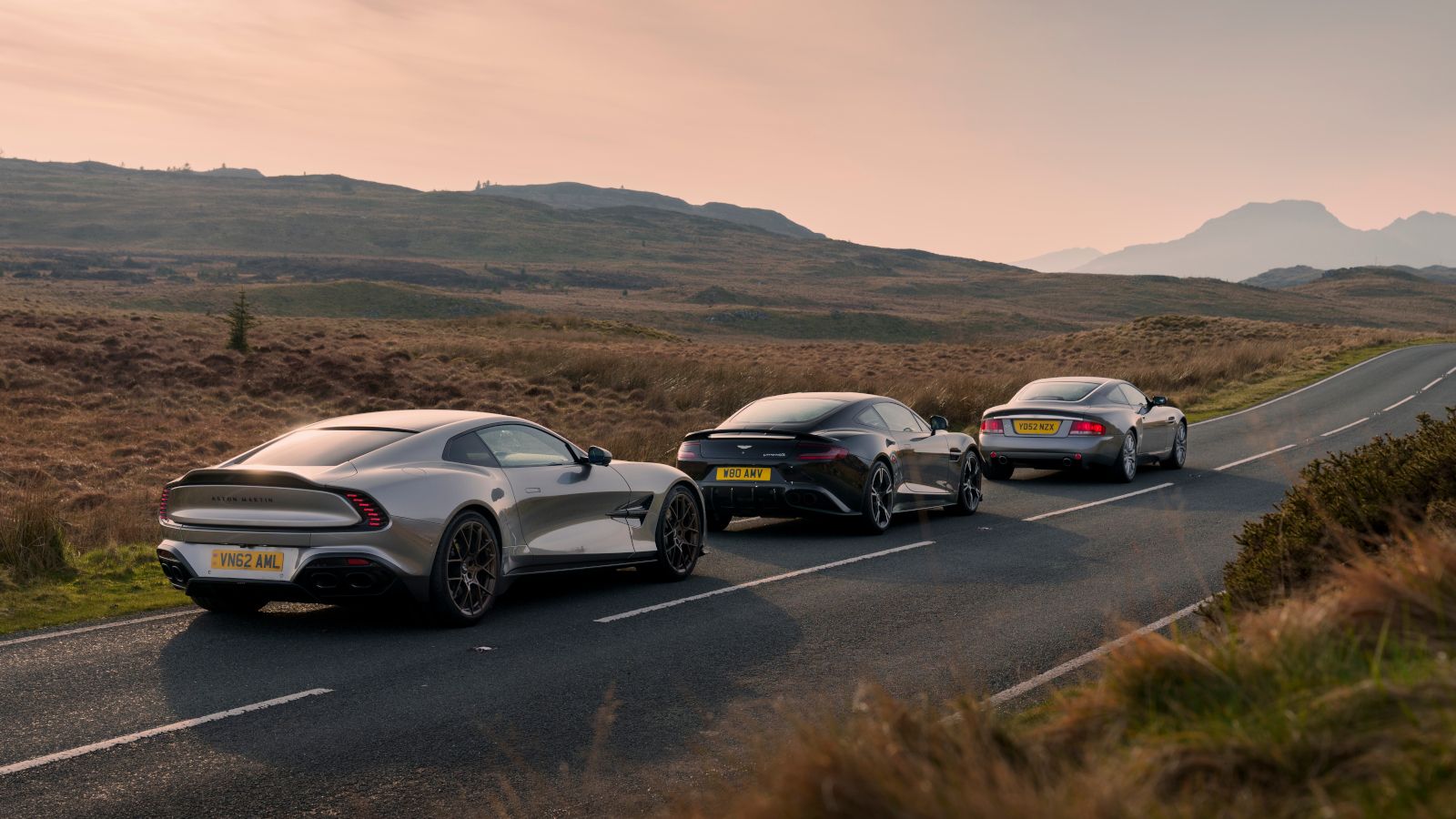
The current third-generation Vanquish, introduced in 2024, marks the most significant powertrain evolution in the nameplate's history. The 5.2-litre twin-turbocharged V12 produces 835 PS (614 kW) and 1000 Nm of torque. Acceleration from 0-60 mph takes 3.3 seconds, with a top speed of 344 km/h (214 mph).
This generation transitions to forced induction, delivering immediate throttle response across the rev range. The bonded aluminium structure provides a rigid foundation for the advanced suspension systems.
Third-generation specifications:
- 835 PS (614 kW) from 5.2-litre twin-turbo V12
- 1000 Nm of torque
- 0-60 mph: 3.3 seconds
- Top speed: 344 km/h (214 mph)
- Bonded aluminium structure
- Carbon ceramic brakes standard
- Limited to fewer than 1000 examples annually
The third-generation Vanquish maintains the front-engined, rear-drive layout that defines traditional GT architecture. Advanced suspension systems and standard carbon ceramic brakes ensure the chassis can exploit the twin-turbo V12's output.
Comparing Three Generations of Flagship Performance
|
Feature
|
2001 V12 Vanquish
|
2012 Vanquish
|
2024 Vanquish
|
|
Engine
|
6.0L V12 (naturally aspirated)
|
6.0L V12 (naturally aspirated)
|
5.2L twin-turbo V12
|
|
Power
|
460 bhp (343 kW)
|
565 bhp (421 kW)
|
835 PS (614 kW)
|
|
Construction
|
Aluminium/carbon composite
|
Full carbonfibre body
|
Bonded aluminium
|
|
Transmission
|
F1-style paddle-shift
|
Automated manual
|
Advanced automatic
|
|
Brakes
|
Standard
|
Carbon ceramic standard
|
Carbon ceramic standard
|
The progression reveals a clear trajectory: each generation delivers substantially more power while refining the technologies that define modern GT performance.
Why the Vanquish Remains Aston Martin's Flagship
The Vanquish has maintained flagship status across 25 years because it consistently delivers what discerning GT buyers prioritize: a naturally engaging driving experience wrapped in hand-crafted luxury. Unlike mid-engined supercars that prioritize track capability, the Vanquish focuses on long-distance comfort without sacrificing performance.
Flagship attributes across all generations:
- Front-engined V12 layout for balanced weight distribution
- Hand-crafted interior with bespoke materials
- Advanced construction methods (composite, carbonfibre, bonded aluminium)
- Driver-focused dynamics with grand touring refinement
- Exclusive production numbers (third generation limited to under 1000 annually)
The Vanquish occupies a distinct position in Aston Martin's lineup. It delivers more power than the DB12, offers greater exclusivity than the Vantage, and provides a more traditional GT experience than the mid-engined Valkyrie. This positioning has remained consistent since 2001.
The Evolution of V12 Performance in a Changing Market
The Vanquish's 25-year evolution mirrors broader industry shifts. The first generation's naturally aspirated V12 and automated manual transmission were advanced technology in 2001. By 2012, carbonfibre construction and dual variable valve timing became the new benchmarks. The 2024 model's twin-turbo V12 delivers performance that would have been unimaginable in 2001.
Each generation has adapted to regulatory and market pressures without diluting the core formula. The twin-turbo V12 delivers linear power delivery through sophisticated boost mapping and throttle calibration.
For buyers evaluating the current Vanquish, this heritage matters. The 2024 model offers the culmination of 25 years of continuous refinement, incorporating lessons learned across two prior generations. The bonded aluminium structure, advanced suspension systems, and twin-turbo V12 deliver a driving experience that meets contemporary performance standards.
Experience the Vanquish Legacy at Aston Martin Montréal
The Vanquish's 25-year evolution from 460 bhp to 835 PS demonstrates Aston Martin's commitment to the front-engined V12 GT formula. Each generation has advanced construction methods, transmission technology, and power delivery while preserving the attributes that define flagship grand touring performance. Visit Aston Martin Montréal in Montréal to explore the current Vanquish and its position within Aston Martin's heritage.